

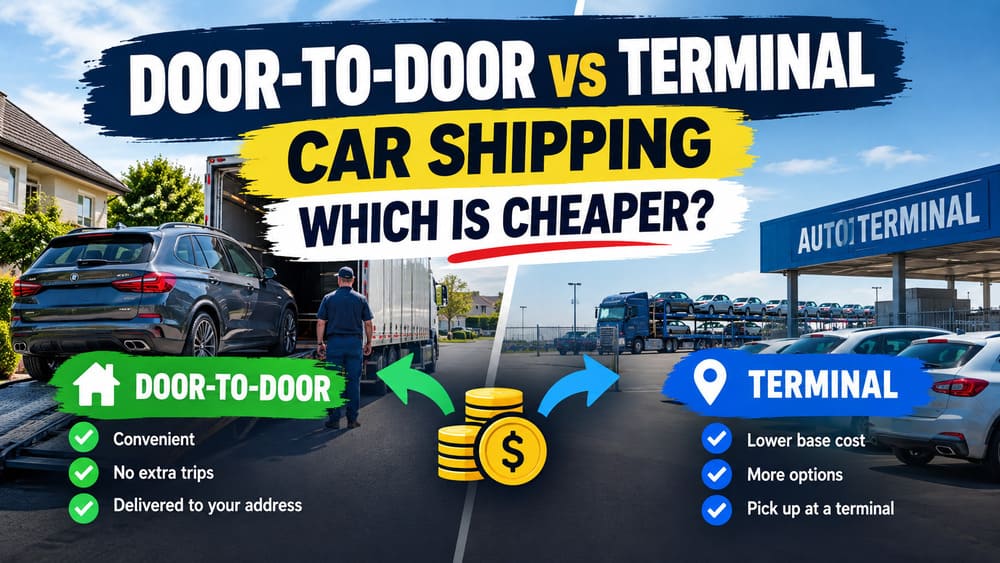
Terminal-to-terminal is the option everyone asks about and almost nobody uses. It saves 5–10%, which sounds worth having until you price the two trips to the terminal and the storage clock that starts when your car arrives. Door to door car shipping accounts for roughly 95% of moves, and the main thing people get wrong about it is the word “door” — a 75-foot carrier is not coming down your street, and that is normal rather than a problem. This guide covers how each option actually works, the arithmetic that decides between them, and the few cases where a terminal genuinely wins.
What is door-to-door car shipping?
Door-to-door car shipping means the carrier collects your vehicle at your address and delivers it to your destination address, with no terminal or depot in between. It is the default in the US, available in all 50 states, and what you get unless you specifically ask otherwise.
The qualifier is physical access. Federal rules allow auto carriers to run 65 to 75 feet long, and a loaded truck stands over 13 feet tall — the US Federal Highway Administration publishes the governing size and weight limits, which carve out that specific length allowance for auto and boat transporters. A vehicle that size cannot turn into most residential streets, and in many places it is not legally permitted to try.
So “door” means as close to your door as a legal, safe manoeuvre allows. In practice that is often your driveway, and often a wide parking lot two streets away.
What terminal-to-terminal actually means now
Terminal-to-terminal means you drive your car to a storage yard, the carrier collects it from there, and you collect it from a second yard at the other end. You handle both first and last miles yourself.
It used to be the standard model. It is not any more, and the reason is structural rather than fashionable: as the interstate network and carrier density improved, running a truck to an address stopped being meaningfully harder than running it to a depot. Terminals now exist mainly in large metros, and many brokers no longer offer the option at all.
That availability gap matters more than the price. Door-to-door covers every state. Terminals cluster in major urban areas, so for most people the choice is theoretical — the nearest terminal is a two-hour drive, which is not a saving.
Side by side
| Door-to-door | Terminal-to-terminal | |
|---|---|---|
| Price | Baseline | About 5–10% less |
| Availability | All 50 states | Major metros only |
| Share of shipments | Roughly 95% | Small minority |
| Your effort | Meet the driver once at each end | Two round trips to terminals |
| Scheduling | Carrier works to your window | Carrier may wait for a full load |
| Storage | None | $15–$35 per day after the free period |
| Enclosed transport | Available | Usually not offered |
| Modified or lifted vehicles | Accepted with notice | Often refused |
| Weather exposure | Transit only | Transit plus yard time |
What “door” really means
This is the part worth understanding before pickup day, because almost every complaint about door-to-door service traces back to a misunderstanding here.
A carrier cannot legally or safely bring a 75-foot truck into:
- Narrow residential streets, particularly in older neighbourhoods laid out before trucks this size existed
- Gated communities, where internal roads and gate heights rule it out and the HOA often prohibits it outright
- Apartment complex car parks, where the turning circle does not exist
- Streets with low branches or utility lines, since a loaded carrier needs roughly 13 feet 6 inches of clearance
- Dense urban cores such as Manhattan, central San Francisco or downtown Chicago
- Unpaved or steep driveways, where the truck risks grounding or getting stuck
When any of these apply, the driver arranges to meet you at the nearest workable spot — typically a supermarket or shopping centre car park, a wide side street a block or two away, or a major intersection. You drive the car there, or drive from there. It adds ten minutes.
A good company flags this at booking rather than at pickup. If nobody has asked about your street, ask them. Rural addresses genuinely off a corridor are the one case where access becomes a price issue rather than a logistics one, and a surcharge of roughly $50–$150 is normal there.
The arithmetic that usually decides it
Run the numbers on a real move before choosing a terminal.
Take a cross-country sedan at roughly $1,300 door-to-door. A 10% terminal saving is about $130. Against that:
- Two round trips to terminals, which for most people means 60–120 miles of driving plus someone to follow you or collect you
- Storage at $15–$35 per day once the free period ends
- A delivery you must be available to collect, rather than one that comes to you
At $25 a day, five days of storage erases the entire saving. And storage days accumulate easily in this model, because terminal shipments often wait for a carrier to fill a load rather than dispatching on your schedule.
The saving holds only when three things are true at once: you live near a terminal, you can collect promptly at the other end, and your dates are flexible enough that waiting costs you nothing. If any one of those fails, door-to-door is cheaper in practice even though it is dearer on paper.
Price your own lane before deciding, since the percentage saving on a short move is smaller in absolute terms than the driving it requires. The car shipping cost calculator gives the current range for your route.
When a terminal genuinely wins
Four situations, and they are narrower than the marketing suggests.
You need the car stored between dates. If your lease ends on the 1st and the new place is available on the 10th, a terminal solves a real problem. You are buying storage, and the transport saving is incidental.
Your address is genuinely unreachable. Not merely narrow — unreachable. Some island, mountain and deeply rural addresses qualify, and in those cases a terminal is less awkward than a long meetup drive at the carrier’s convenience.
You live and are moving between two major metros. Both terminals close, both trips short, and the saving survives contact with reality.
You are travelling separately and nobody will be at either end. A terminal accepts the car on its own schedule; a driver cannot wait around for a handover.
Note what is absent from that list: wanting enclosed transport, shipping a classic or modified vehicle, or moving an inoperable car. Terminals usually decline all three. The vehicle shipping profile tool shows what your car actually needs, and enclosed carriers work door-to-door by default.
How to choose
- Check whether a terminal exists near both ends. If either is more than about 45 minutes away, the question is settled.
- Price both. Ask the same company for both quotes rather than comparing across companies, so the only variable is the service.
- Ask how many free storage days are included, and the daily rate afterwards. Then ask what happens if the carrier is late.
- Ask whether the terminal shipment waits for a full load. If yes, treat the quoted transit time as a minimum rather than an estimate.
- Describe your street honestly if you choose door-to-door. Gated, narrow, unpaved, low branches — say so at booking. The meetup is routine; the surprise is not.
- Confirm what covers the car in the yard. The carrier’s cargo insurance applies in transit, typically $100,000–$250,000 per load on open carriers and higher on enclosed. Terminal storage may be covered differently, or not at all, so ask before you leave the car there.
- Verify the company either way. Run the USDOT or MC number through the company lookup tool before paying a deposit.
Next step: see what both options cost on your actual route before you commit. Price your lane now →
Frequently asked questions
Does door-to-door car shipping really come to my door?
As close as the law and physics allow. Auto carriers run 65 to 75 feet long and stand over 13 feet tall loaded, so they cannot enter most residential streets, gated communities or apartment car parks. The driver will arrange to meet you at the nearest safe spot, usually a large car park or a wider street a block or two away. This is standard practice rather than a downgrade, and a good company mentions it when you book.
Is terminal-to-terminal car shipping cheaper?
On the quote, yes — usually 5–10% less. In practice the saving often disappears. You drive to and from terminals at both ends, and storage runs $15–$35 per day once the free period ends. On a $1,300 cross-country move, the roughly $130 saving is gone after about five days of storage. It only holds up if you live near both terminals and can collect promptly.
Do car shipping terminals charge storage fees?
Yes, typically $15–$35 per day depending on location, after a free period that varies by terminal. Ask for both numbers in writing before booking. Storage days accumulate more easily than people expect, because terminal shipments often wait for a carrier to fill a load rather than dispatching to your schedule.
Can I ship an inoperable or modified car terminal-to-terminal?
Usually not. Terminals commonly refuse vehicles that do not run, as well as lifted, lowered or heavily modified cars, because handling them needs equipment a yard may not have. Enclosed transport is generally unavailable through terminals too. For any of these, door-to-door with a carrier equipped for the job is the practical route.
What if the truck cannot reach my street at all?
The driver meets you nearby, which resolves almost every case. Genuinely unreachable addresses — some island, mountain or deeply rural locations — are the exception, and there a terminal or a shorter self-drive leg may make more sense. Rural addresses well off a main corridor can also carry a surcharge of roughly $50–$150, so mention the location when you request the quote rather than after booking.