

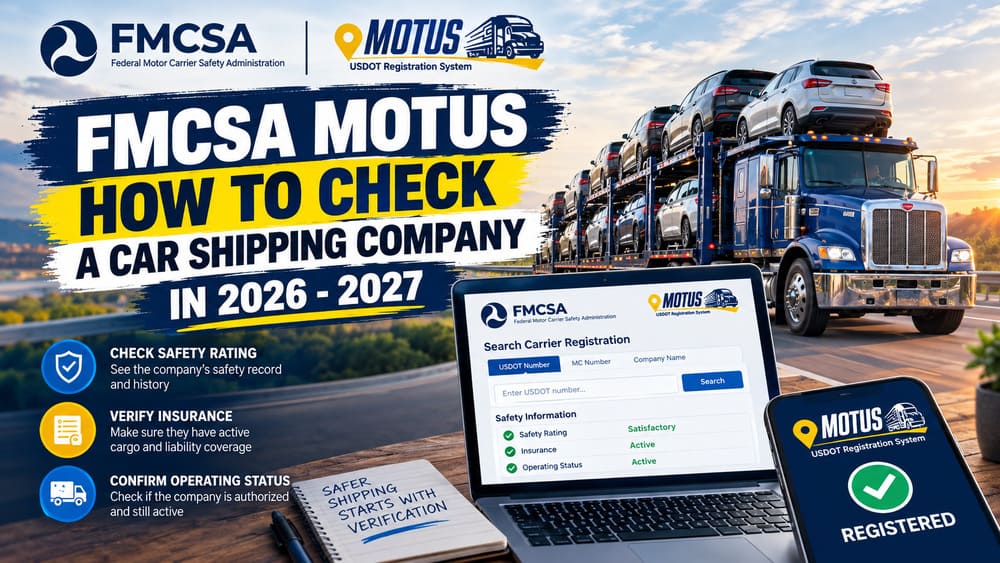
In May 2026, the Federal Motor Carrier Safety Administration (FMCSA) shut down the systems it had used for three decades to register trucking companies and switched to a new one called Motus. If you are about to hand your car to a shipping company, that switch matters more than it sounds. For now, two sets of federal records exist side by side, they don’t always agree, and a company can look licensed in one place while it is suspended in the other. This guide explains what changed, what went wrong during the rollout, and how to check a car shipping company correctly while the dust settles.
The short version
- Motus replaced FMCSA’s old registration systems on May 14, 2026. Carriers and brokers now apply for authority, file insurance and update their records there.
- Your checklist hasn’t changed: the company still needs an active USDOT number, active operating authority (an MC number) and insurance on file.
- What changed is where the truth lives. Status changes made since May — suspensions, revocations, reinstatements — are recorded in Motus. Older public data files can still show the status a company had before.
- The rollout was rough. Carriers reported frozen accounts, missing filings and authorities switched off by mistake, so a single record can be wrong in either direction.
- Check at least two sources, look at the dates, and ask for a certificate of insurance. Our free car shipping company lookup reads the Motus records and the older files together and tells you which one it relied on.
What is Motus?
Motus is FMCSA’s new registration system for every company that needs a USDOT number: trucking companies, auto transport carriers, brokers and freight forwarders. The name comes from the Latin word for “movement.” It puts in one place what used to be spread across several aging tools: applying for a USDOT number, applying for operating authority, filing the two-year update known as the MCS-150, and managing who is allowed to act for the company.
The old tools were retired for good at 8:00 p.m. Eastern on May 14, 2026. That included the Unified Registration System used for new applications, the Licensing and Insurance (L&I) system used for authority and insurance filings, and the registration functions of the FMCSA Portal. There was no grace period.
The main goal is fraud prevention. Under the old setup, it was relatively easy to register a trucking company with little proof of who was behind it, and to reopen under a new name after being shut down. Regulators call those operators “chameleon carriers.” In Motus, the person who controls a company’s record has to sign in through Login.gov and verify their identity with a government ID and a face scan. According to the load board operator DAT, that verification runs through IDEMIA and CLEAR and needs a smartphone or tablet. When he announced the system, Transportation Secretary Sean Duffy said that “dangerous foreign drivers and shell companies have been taking advantage of this lax, decrepit federal registration system for years.”
For people shipping a car, that is good news in the long run. A company that has to prove who its owner is is harder to fake. The short run has been messier.
What changed for you, and what didn’t
If you ship a car once or twice in your life, you don’t need to learn Motus itself. You will never log into it. But a few practical things changed in the records you rely on.
The numbers you check are the same
The USDOT number is still the main federal ID for a transport company. MC numbers are still around too, even though FMCSA had planned to replace them with suffixes on the USDOT number. In its Federal Register notice of April 29, 2026, the agency said that eliminating MC and FF docket numbers was not part of the Motus release. So you should still ask every company for both its USDOT number and its MC number.
New companies get much longer MC numbers
Companies that received authority through Motus are being issued MC numbers in a new, much longer series — eight digits, such as MC-94763161, instead of the six- or seven-digit numbers you may be used to. A long MC number is not a red flag on its own. It simply tells you the company is new to the system, which is worth knowing: most car shipping scams use freshly registered names.
The public lookup is still SAFER
FMCSA’s public Company Snapshot at safer.fmcsa.dot.gov was not retired. It remains the official place to read a company’s record without logging in. Motus is where companies change their records; SAFER is where the public reads them.
The open data changed
FMCSA also publishes its records as open data on data.transportation.gov, which is what most third-party lookup sites read. Since June 3, 2026, a separate set of Motus files has appeared there next to the older ones. That detail turns out to be the source of most of the confusion, and we come back to it below.
What went wrong during the rollout
Motus did not have a smooth start. Trade publications that cover trucking documented problems from the first week, and some of them directly affect what you see when you look a company up.
- Locked-out carriers. On May 19, carriers could not claim their USDOT records in Motus, which blocked address changes, MCS-150 updates and reinstatements. FMCSA fixed that particular issue by the next morning, according to Land Line, the news outlet of the Owner-Operator Independent Drivers Association.
- A support backlog. CCJ reported that more than 120,000 user applications and thousands of account claims arrived right after launch, more than the agency was staffed to handle. Carriers described hours on hold.
- A pause on deactivations. FMCSA stopped deactivating USDOT numbers for companies that missed their biennial update after June 1, to give everyone time during the transition, Land Line reported in July.
- Bad data carried over. Agency officials told CCJ that the old database was fragile and that about a quarter of four million update letters had bounced because of wrong carrier addresses. Errors in the old records moved into the new system.
The more serious problems involved the records themselves. In a webinar covered by CCJ, the compliance firm Central Analysis Bureau listed errors it had seen in Motus: out-of-service orders that did not show up, insurance requirements that changed on their own, valid operating authorities that were revoked without a reason, old insurance policies that did not drop off after being replaced, and excess insurance limits displayed in a way that made coverage look bigger than it was.
Those errors have real consequences. CCJ described a carrier whose process-agent filing (the BOC-3 form every interstate company must keep) was removed without warning on August 20. At a routine weigh-station stop in Oklahoma, inspectors looked up the truck, saw that its federal authority was inactive and declared it unable to continue. In another case, FMCSA reactivated a carrier on September 11, less than a day after its story was published. That fix came quickly, but it shows how a correct record can turn incorrect overnight.
For someone shipping a car, the lesson cuts both ways. A red flag may be a glitch that a legitimate carrier is already fighting. And a clean-looking record may be out of date or missing an out-of-service order. Neither is a reason to panic. Both are reasons not to rely on a single screen.
Why two sources can show different answers
This is the part almost nobody explains. FMCSA’s public data currently comes in two generations.
The older files come from the retired L&I system. They hold authority and insurance records for about 1.86 million dockets going back decades, and the portal still refreshes them daily. The Motus files started in June 2026. As of early October 2026 they held records for roughly 155,000 dockets: every company that applied through Motus, plus every older company whose status has changed since the switch.
When we compared the two on October 5, 2026, the gap was easy to see. Carriers that FMCSA had suspended that day in Motus, most of them for insurance cancellations, were still listed as having active authority in the older file. And companies registered through Motus did not exist in the older file at all. In plain terms:
- A tool that reads only the older files can show a suspended company as fully licensed.
- The same tool may say “no company found” for a brand-new, legitimate carrier.
- A tool that reads only Motus can miss companies that haven’t been touched since the switch, and, per the errors listed above, can occasionally miss an out-of-service order.
Here is how the main places to check compare today:
| Where you check | What it’s good for | What to watch for |
|---|---|---|
| FMCSA SAFER Company Snapshot | The official public record: status, authority, insurance on file, inspections, crashes | Shows the current state only, with no history; some people outside the U.S. get an access error |
| Lookup sites built on older FMCSA data files | Long history for established companies | May show stale status after May 2026 and miss companies registered through Motus |
| Lookup tools that read Motus and the older files together | Current status plus history, including past revocations and insurance gaps | Read which source the result came from and when it was checked |
| The company’s certificate of insurance | Exact policy, insurer and limits, including cargo coverage | A certificate can be forged — call the insurer listed to confirm the policy |
How to check a car shipping company now, step by step
The checks take about ten minutes and you only need to do them once per company.
- Get both numbers in writing. Ask for the USDOT and MC numbers and make sure they appear on the quote or contract, not just on the phone. A company that hesitates is telling you something.
- Run the numbers through two sources. Use the FMCSA SAFER snapshot and a lookup that reads the Motus records, such as our car shipping company lookup. If both show active authority and insurance on file, you are in good shape. If they disagree, the record with the more recent status change is the one to believe.
- Match the name. The legal name or “doing business as” name on the record should match the website, the contract and, at pickup, the truck. Identity theft of real carriers is one of the fastest-growing scams in freight, which we cover in our guide to auto transport scams.
- Look at the history, not just today. A company that lost its authority twice in the last two years because insurance lapsed is a bigger risk than one with a clean record, even if both are active today.
- Ask for a certificate of insurance and call the insurer. FMCSA records show liability coverage, but most carriers aren’t required to file cargo coverage — the policy that pays if your car is damaged. Make sure cargo coverage exceeds your car’s value.
- If you booked a broker, check the carrier too. A broker arranges the move and a separate carrier hauls the car. Ask for the carrier’s name and USDOT number before pickup and run the same checks.
- Re-check the day before pickup. Status can change overnight, as the rollout showed. It takes a minute.
How our lookup handles the switch
We built our lookup after running into exactly the problem described above. Reading a single source was producing wrong answers, so the tool now reads 14 FMCSA data files for every company you check and combines them:
- Motus records for current authority, insurance, the process agent and the full history of status changes since the switch.
- The older licensing files for companies Motus hasn’t touched yet, and for history before 2026: past revocations, warnings and insurance changes.
- The company census for the legal name, address, fleet size, drivers and the types of cargo the company is registered to carry.
- Separate federal files for out-of-service orders, roadside inspections and crashes, so a missing order in one record doesn’t hide it.
The rule is simple. If a company has any record in Motus, the newest Motus status wins, because that is where every change since May 2026 is recorded. If it doesn’t, we fall back to the older files, because its status hasn’t changed since the switch. The bottom of every report says which source we used and how long ago the data was checked.
We also translate what the records mean. The report flags authority that is inactive or still pending, revocations and suspensions in the past three years, insurance that lapsed with no replacement, a broker without its required $75,000 bond, out-of-service rates well above the national average, and registrations less than a year old. A clean report is a good start, not a guarantee, and we say so on every page.
What to do if a record looks wrong
Given the rollout problems, you may run into a company that says its “inactive” status is a Motus error. Sometimes that is true. Here is how to handle it.
- Don’t release your car until the record shows active authority. Even if the error is FMCSA’s, inspectors act on what the record says. A truck stopped at a weigh station with your car on it is your problem too.
- Ask what the company has done about it. A real carrier caught in a glitch will usually have an FMCSA ticket number and can tell you when it expects a fix. FMCSA’s registration contact center is 800-832-5560.
- Check the reason on the record. An authority suspended because “insurance cancellation effective” means the insurer told FMCSA the policy ended. Ask for proof of the new policy and call that insurer.
- Have a backup. If the pickup date can’t move, book a company whose record is clean today. Our directory of verified car shipping companies lists companies that passed the same checks.
If the price changes while you wait for a fix, that is a separate issue; our guide to why car shipping quotes go up after booking explains what is normal and what isn’t.
Frequently asked questions
What is FMCSA Motus?
Motus is the registration system FMCSA launched on May 14, 2026. It replaced the Unified Registration System, the L&I filing system and the registration parts of the FMCSA Portal. Trucking companies, auto transport carriers and brokers use it to get a USDOT number and operating authority, file insurance and update their records. Company officials have to verify their identity through Login.gov.
Are MC numbers going away?
Not yet. FMCSA once planned to replace MC numbers with suffixes on the USDOT number, but its April 29, 2026 Federal Register notice said that change was not part of the Motus release. Companies registered through Motus still receive MC numbers, now in a longer eight-digit series.
Can I still use SAFER to check a carrier?
Yes. The SAFER Company Snapshot at safer.fmcsa.dot.gov is still FMCSA’s official public view of a company’s record. It shows the current state only, so pair it with a tool that shows history, such as our lookup.
Why does a company show “active” on one site and “inactive” on another?
Most likely one site reads FMCSA’s older data files and the other reads Motus. Status changes made after May 14, 2026 appear in Motus, while the older files can keep showing the earlier status. The record with the more recent change is usually the right one.
My carrier says its inactive status is a Motus glitch. Should I believe it?
It might be true, since the rollout did switch off some valid authorities by mistake. But don’t hand over your car until the record shows active authority again. Ask for the FMCSA ticket number and proof of current insurance, and check again before pickup.
How often are the federal records updated?
FMCSA refreshes its public data files daily. Our lookup caches each company’s report for up to 12 hours, and every report shows when its data was last checked.