

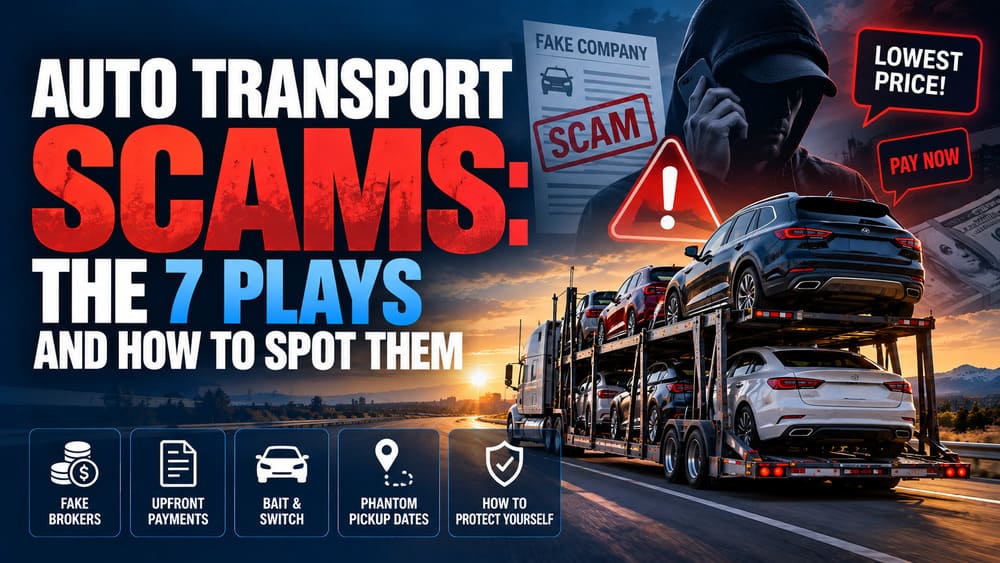
Auto transport scams are not improvised. They follow a small number of repeatable plays, and almost all of them exploit the same structural fact: you hand over a $30,000 asset to a stranger, then wait days to find out whether the arrangement was real. Most operators in this industry are legitimate. The ones who are not rely on you never learning how the booking actually works. This guide explains each play from the inside, separates deliberate fraud from ordinary repricing, and sets out the checks that take five minutes.
What is an auto transport scam?
An auto transport scam is any arrangement where a company takes your money or your vehicle without the authority, intent or capacity to move it as agreed. That covers outright theft, but in practice most cases are quieter: a deposit collected against a price nobody will haul for, or a booking sold on to a company you never agreed to use.
The distinction that matters is between fraud and friction. A rate that rises because diesel moved is a market problem. A rate that was never viable, quoted deliberately to secure a deposit, is a scam. The sections below keep those apart, because confusing them makes people distrust honest carriers and trust dishonest ones.
Why 2026 made this worse
Two pressures converged this year. The first is organised freight crime, which has scaled sharply. In a public service announcement issued on 30 April 2026, the FBI’s Internet Crime Complaint Center reported that cargo theft losses reached nearly $725 million in 2025, a 60% increase over 2024. Confirmed thefts rose 18%, and the average value per theft climbed 36% to $273,990.
The method matters more than the total. According to that bulletin, criminals compromise transportation companies’ email systems through phishing, then impersonate those legitimate carriers on load boards to intercept shipments. In other words, the company name your broker checked may be real while the entity that collects your car is not.
The second pressure is economic. Diesel hit a record national average in mid-September 2026, and carrier pay per mile rose 22.8% across the first half of the year. Squeezed margins push marginal operators toward aggressive quoting. They also make genuine price movement more common, which gives fraudsters cover — a suspicious increase is easier to sell when everyone’s prices are moving.
The seven plays
1. The lowball bait-and-switch
The quote arrives well below everyone else’s. You book, pay a deposit, and the price rises once the car is committed. The mechanism is simple: the quote was never posted to carriers at that number, or it was posted and no driver accepted it.
Deliberate lowballing is recognisable by its arithmetic. If four companies quote within 15% of each other and one comes in 40% under, that fifth number is not a discount. Nobody has a cost advantage of that size on the same lane with the same equipment.
Tell: the price drops further when you hesitate. A real quote has a floor set by what a driver will accept. A bait quote has no floor because it was never going to be paid.
2. The vanishing deposit
An unlicensed operator collects a large “reservation” or “securing” fee before any carrier has been assigned, then stops answering. Because no dispatch ever happened, there is no truck, no bill of lading and no paper trail beyond your payment.
Legitimate practice looks different. Deposits are typically $100–$250, and reputable brokers take them after a carrier has been assigned to the load, not before. A demand for a large deposit up front, especially by wire, Zelle, Venmo, cryptocurrency or gift card, is the single clearest red flag in this industry.
Tell: payment is requested through a method with no chargeback rights.
3. The hostage vehicle
This one begins legitimately. The car is collected, and then a new charge appears — the vehicle was larger than stated, the address is out of area, fuel rose — with delivery withheld until it is paid. Leverage is the entire play, and it only works after pickup.
Your protection here is documentary. The bill of lading records the vehicle, its condition and the agreed terms at pickup. Photograph the car and keep the signed copy. A carrier refusing to release a vehicle against an agreed, documented rate is a matter for the FMCSA, and in some circumstances for the police.
Tell: the new charge is communicated by phone only, and nobody will put it in writing.
4. The cloned company
Fraudsters copy a real company’s name, USDOT number, branding and reviews onto a new website and phone number. You research the legitimate business, find a clean record, and then pay the impostor. The 2026 fraud data shows this pattern moving upmarket, with criminals compromising genuine carriers’ email accounts so the impersonation survives a casual check.
Defeat it by starting from the regulator rather than from the website. Look up the USDOT or MC number in FMCSA records, then call the phone number the federal record lists — not the one on the site that quoted you. If the two differ, you have your answer. The company lookup tool runs that check against FMCSA data in one search.
Tell: a domain registered recently, stock photography, and a number that goes to voicemail during business hours.
5. The phantom broker
Some operators have no authority at all. Brokering vehicle transport requires FMCSA operating authority, an MC number and $75,000 in financial security, filed either as a BMC-84 surety bond or a BMC-85 trust fund. An operator without those is not a discount option. They are unlicensed.
One widely held belief is worth correcting here. That $75,000 bond exists chiefly to protect carriers when a broker fails to pay them for completed work. It is not a consumer compensation fund, and recovering from it as a private customer is difficult. Treat the bond as evidence that a business cleared a regulatory bar, not as insurance on your car.
Tell: the company cannot produce an MC number, or produces one that belongs to a different business name.
6. The hidden accessorial
The headline rate excludes charges that were always going to apply: fuel adjustment, residential delivery, oversized or lifted vehicle, inoperable handling, terminal storage, expedited pickup. Each is a normal industry charge. The deception is in withholding them until the car is committed.
Ask for an itemised written quote that names the total and lists which accessorials could apply and at what rate. A company unwilling to put that in an email is telling you something. If you are unsure which surcharges genuinely apply to your vehicle, the vehicle shipping profile tool shows what equipment your car actually needs.
Tell: refusal to send a written, itemised quote.
7. The double-brokered load
You hire a company. That company, rather than dispatching a vetted carrier, re-posts your car to a load board and sells it to whoever takes it. You end up with an operator nobody screened, often one you cannot identify until the truck arrives.
Double brokering is where consumer fraud meets the organised freight crime in the FBI data, because a re-posted load is exactly what impersonators shop for. It also destroys your recourse: the insurance you were shown belongs to a company that never touched the car.
Tell: the driver’s company name does not match anything you agreed to, and nobody will explain the discrepancy.
The one that is not a scam
Not every price increase is fraud, and treating it as such will cost you a working booking. Rates in this industry are set on a live market. A broker posts your car at a price; if no driver accepts it within a few days, the price has to rise or the car does not move.
That mechanism has been unusually visible in 2026. Repricing after booking rose 46% year over year, and the share of orders cancelled because the booked rate attracted no truck at all tripled, from 1.45% to 4.64% of bookings. Roughly one booking in twenty now fails for that reason alone.
Three signals separate honest repricing from a bait-and-switch:
| Honest repricing | Bait-and-switch | |
|---|---|---|
| Timing | Before pickup, while the car is still with you | After pickup, when leverage exists |
| Explanation | Specific: no carrier accepted at the posted rate | Vague: “fuel”, “the route changed” |
| Your options | You may cancel and get the deposit back | Cancellation is refused or penalised |
The practical rule: a company that raises the price before it has your car, explains why, and lets you walk away is operating normally. A company that discovers the problem only after collection is not.
Checking a company before you pay
Five minutes of verification defeats most of the plays above. Work in this order.
- Get the USDOT or MC number in writing. A company that will not provide one has ended the conversation for you.
- Verify it against FMCSA records, not the company’s own site. Confirm the legal name, the operating authority is active, and the insurance is on file. The company lookup tool checks this directly.
- Call the number in the federal record. This is the step that catches cloned companies, and almost nobody takes it.
- Establish who will actually touch the car. Ask whether you are hiring a broker or a carrier, and whether the load may be re-posted. Carriers running their own trucks remove that uncertainty; brokers are legitimate and often necessary, but you should know which you have.
- Insist on an itemised written quote naming the total, the deposit, the balance, the payment method and the possible accessorials.
- Pay by a traceable method. Credit card or ACH preserves a dispute route. Wire, Zelle, crypto and gift cards do not.
- Sanity-check the number. Price the lane yourself with the car shipping cost calculator so you can recognise a quote that is too good to be real.
Every company in this directory is checked against FMCSA records before listing; the verification method sets out exactly which fields are checked. You can also filter for companies with a satisfactory FMCSA safety rating or browse the map of companies by state to find one already operating near you.
If you are already in one
Act in this order, and keep everything in writing.
Stop further payments immediately and contact your card issuer or bank about a dispute, because that window closes faster than most people expect. Gather your paperwork: the quote, the booking confirmation, the bill of lading, every message and every payment record. Then file with the FMCSA’s National Consumer Complaint Database, which is the federal channel for complaints against carriers and brokers. Where a cloned company or compromised email is involved, the FBI accepts reports at IC3.gov.
If the car was delivered damaged rather than withheld, that is a cargo claim rather than a fraud report, and it runs on its own deadlines. The damage claim assistant covers the evidence and timing for that route.
Next step: check the company before the deposit leaves your account. Look up a USDOT or MC number →
Frequently asked questions
How do I know if a car shipping company is legitimate?
Ask for the USDOT or MC number, then verify it in FMCSA records rather than on the company’s own website. Confirm that the legal name matches, that operating authority is active, and that insurance is on file. Then call the phone number listed in the federal record, which is the step that exposes cloned companies. A legitimate broker will also give you an itemised written quote and accept a traceable payment method.
Is it normal to pay a deposit for car shipping?
Yes, but the size and timing matter. Deposits of roughly $100–$250 are standard, and reputable brokers take them once a carrier has been assigned rather than at first contact. A large deposit demanded before any carrier is assigned, or payment requested by wire, Zelle, cryptocurrency or gift card, is the strongest single warning sign in this industry.
Why did my car shipping price go up after I booked?
Usually because no driver accepted the posted rate. Carriers choose loads from a live board, so a rate set too low simply sits there. In 2026 this became much more common: repricing after booking rose 46%, and the share of orders cancelled because no truck would take the rate tripled to 4.64%. That is a market problem rather than fraud — provided the company tells you before pickup, explains the reason, and lets you cancel for a refund.
What is double brokering and why does it matter?
Double brokering is when the company you hired re-posts your vehicle to a load board and sells it to another operator instead of dispatching a carrier it has vetted. It matters because the truck that arrives was screened by nobody, and the insurance you were shown belongs to a company that never handled your car. Ask directly whether your load may be re-posted, and confirm the carrier’s identity before pickup.
Does the $75,000 broker bond protect me if something goes wrong?
Not in the way most people assume. Federal rules require brokers to hold $75,000 in financial security, filed as a BMC-84 surety bond or a BMC-85 trust fund, but that security exists chiefly to protect carriers when a broker fails to pay them. Claiming against it as a private customer is difficult. Treat the bond as proof that a business cleared a regulatory bar, and rely on the carrier’s cargo insurance and your own payment protections for actual recovery.