

Founded in 1984, locally owned and operated Texas Auto Carriers provides transport, towing, and hauling services for consumer and commercial clients. Our…
Find car shipping companies
Tools
Popular cities
Popular routes
Service guide · Enclosed transport
Compare 167 verified companies that ship cars in enclosed trailers, see what enclosed transport costs for your distance, and find out when it is worth paying more than for an open carrier.
Founded in 1984, locally owned and operated Texas Auto Carriers provides transport, towing, and hauling services for consumer and commercial clients. Our…

We are a family owned and operated nationwide auto transport and auto moving company with long experience specializing in shipping cars around the United…

J&S Transportation delivers vehicles for private individuals and dealerships across the United States. We’ve shipped over one million vehicles and…

Eagle Auto Transport is a leader in auto transport and vehicle shipping industry for its competitive prices and on time transportation! If you are looking for…

At Echo Road Auto Car Transport, we are committed to providing safe, dependable, and hassle-free vehicle shipping services for customers across the United…

At Above Auto Transport, we are committed to guiding you through every step of your vehicle shipping journey with care and expertise. Trust us for…

Each move is unique, factoring in variables like size, distance, and more. Moreover, each auto transport company or moving firm has its distinct pricing and…

At Thrifty Auto Shipping, we understand the importance of finding a reliable auto transport company that will handle your vehicle with the utmost care. Our…

Our family-owned business has been in the auto industry since 1995 helping our local community as well as other clients with their automotive needs. Powered…

Established in 2011, Acme Car Shipping has grown into a trusted partner in vehicle transportation. As the best car shipping company for moving and relocation…

AG Car Shipping stands out by demanding full cargo insurance coverage from every active carrier, eliminating hidden broker fees, and providing 24/7 dedicated…

We understand every shipment matters. That's why we combine the reach of a nationwide network with personalized support for every customer. From quote to…

At Andrew Auto Transport, we provide secure, stress-free vehicle shipping solutions tailored to your needs. Our door-to-door service makes transporting your…

Auto Express Inc. started in Long Island, NY—a market most drivers avoided. We fearlessly traversed the entire country, accustomed to every challenge we faced…

The owner started riding along on transport runs from New England to Florida with his father as a kid, learning the business from the ground up — how loads…

Dedicated to providing quality and hassle-free experiences to all its clients, Autoplex has been surpassing the expectations of many. Started as a small…

Founded in 2007, AutoStar Transport Express is a trusted leader in the auto transport industry, specializing in safe, efficient, and reliable vehicle…

We’re committed to revolutionizing automotive transport through industry-leading safety standards, cutting-edge technology, and exceptional customer service…

Founded in 2016 and headquartered in North Hollywood, California, BAH Logistics LLC is a federally licensed auto transport broker. We connect customers with a…

Looking for a reliable and stress-free way to ship your vehicle? For the past seven years, Beam Me Up Auto Transport has been a trusted name in car transport…

Reliable & Professional nationwide transport for vehicles,cars,trucks, machinery equipment,motorcycles, trailers, boats, RVs, Freight,Power only,Tow away…

Why choose Bold Auto Transport comes down to one thing most car shipping companies cannot offer: a licensed, federally authorized broker that coordinates your…

At Coastal Auto Shipping, we’re not just transporting vehicles; we’re crafting a seamless and top-tier experience for both individuals and businesses. Setting…

Compass Transport offers auto shipping services at reasonable pricing while never sacrificing your needs as a customer. While you may find companies that…

We provide expedited vehicle shipping domestic and internationally at competitive rates. We also offer a wide variety of equipment, such as flat beds, tow…

In 2004, Direct Express Auto Transport changed the vehicle logistics industry forever. Before we launched, getting a car shipping quote meant hours of phone…

FAST AUTOSHIP LLC, based in Austin, Texas, is dedicated to providing exceptional auto shipping services throughout the entire country. While we have a single…

Fast Car Shipping provides nationwide auto transport for customers who need a vehicle moved from one location to another. We help coordinate vehicle shipping…

Established in 2011, Federal Auto Shipping is a leader in the auto transport industry, committed to delivering exceptional service and customer satisfaction…

Founded in 2021 by two brothers with extensive experience in leading auto transport companies, Flix Auto Transport was built on a shared passion for…
No companies match these filters
Try fewer filters.
How it works
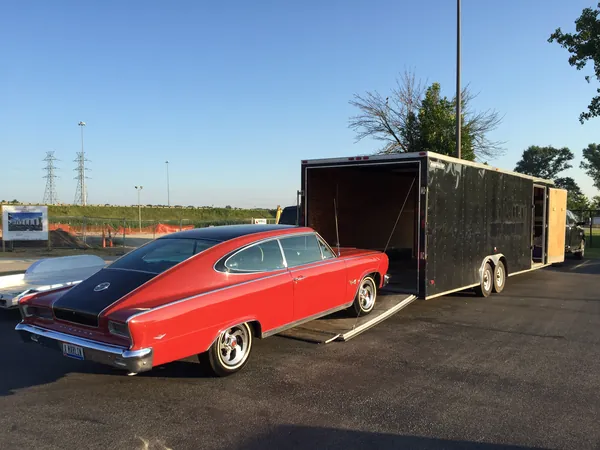
Enclosed car shipping moves your vehicle inside a covered trailer instead of on the open, two-deck carriers you see on the highway. The car rides out of the rain, sun and road salt, away from stones thrown up by traffic, and out of sight. Most enclosed trailers load with a hydraulic liftgate or low-angle ramps and hold the car by its tires.
Only about one car in ten ships this way. Enclosed trucks mostly carry collector and classic cars, exotics, high-end cars sold by dealers and at collector auctions, cars on their way to and from shows, race and track cars, and the cars of owners who move with something they would rather not see chipped.
Each truck carries fewer cars and the equipment costs more, so the price is higher and far fewer trucks run each route. That is why it pays to book early and to compare what each company will actually send, not just the price.
Estimated prices
Enclosed transport usually costs about 40–60% more than an open carrier for the same route. Typical ranges for a running sedan with a flexible pickup date:
| Distance | Open carrier | Enclosed trailer | Extra for enclosed | Transit time |
|---|---|---|---|---|
| 250 miles | $500–$850 | $750–$1,275 | +$250–$425 | 1–2 days |
| 500 miles | $625–$1,000 | $950–$1,500 | +$325–$500 | 1–3 days |
| 1,000 miles | $850–$1,250 | $1,275–$1,875 | +$425–$625 | 2–5 days |
| 1,500 miles | $1,025–$1,450 | $1,525–$2,175 | +$500–$725 | 3–6 days |
| 2,000 miles | $1,150–$1,650 | $1,725–$2,475 | +$575–$825 | 4–8 days |
| 2,800 miles coast to coast | $1,400–$2,000 | $2,100–$3,000 | +$700–$1,000 | 6–10 days |
An SUV costs about 12–25% more and a pickup about 30% more. Prices rise in summer and on snowbird routes in season. A single-car enclosed trailer is the most expensive option of all. Calculate your exact car and route →
Open or enclosed?
Most cars, including new cars from the factory, travel on open carriers, and damage on them is rare. Enclosed transport earns its price when a stone chip, road grime or a wet delivery would be a real loss.
Not sure? Our open or enclosed finder checks your exact car — size, weight and ground clearance — against what carriers can take.
What you are booking
"Enclosed" covers several kinds of equipment. Ask which one will carry your car, because they differ in protection, loading and price.
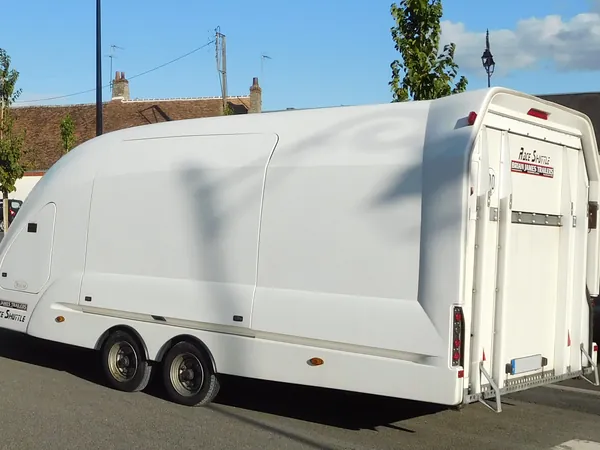
Solid walls and roof. The best protection from weather, debris and prying eyes, and the usual choice for exotics and high-value cars.
Heavy curtain walls on a frame. They keep out rain and road debris at a lower price, but a curtain is less protection from impacts than a hard wall.
A pickup or a hotshot truck pulling one or two cars. Fewer stops and more attention per car, at the highest price per vehicle.
Semi trailers carrying up to about 6–7 cars on two decks. The most common and the cheapest enclosed option on long routes.
Lift the car level instead of driving it up a ramp. Essential for cars with low ground clearance, splitters or long front overhangs.
Wheel nets and soft straps hold the car by its tires, so nothing is hooked to the frame or the suspension.
Sizes and requirements
An enclosed trailer has walls, a roof and a door, so unlike an open carrier it has hard limits. These are the numbers that decide whether your car goes in, and which kind of trailer it needs.
Typical figures from builders' published specs for 8.5 × 24 ft enclosed car haulers. Every trailer is different, so give the carrier your car's measured height, width and length. Car drawings: Freepik.
| Trailer | Cars | Space inside | Loading and limits |
|---|---|---|---|
| Single-car trailer 8.5 ft wide, 20–24 ft long, behind a pickup | 1 | 78–84 in tall, about 96 in wide, 81–84 in between the wheel wells | Rear ramp door 89–94 in wide and 72–81 in tall; some have a liftgate |
| Two-car lift-deck trailer Gooseneck behind a heavy pickup | 2 | One car on the floor, one on a hydraulic upper deck | Headroom under and over the upper deck is limited, so tall vehicles ride on the floor |
| Multi-car enclosed semi Up to 53 ft | 6–7 | Two decks with hydraulic upper positions | Rear liftgate. Top-deck spots take cars up to about 6 ft tall; the loaded truck has to stay under about 13.5 ft in most states |
| Vehicle | Typical height | Length | Single-car trailer | Multi-car trailer | Loading |
|---|---|---|---|---|---|
| Small car | 52–58 in | 12.5–14.7 ft | Fits | Top or bottom deck | Low ramps or liftgate |
| Compact car | 55–58 in | 14.3–15.5 ft | Fits | Top or bottom deck | Ramps or liftgate |
| Midsize sedan | 56–58 in | 15.5–16.3 ft | Fits | Top or bottom deck | Ramps or liftgate |
| Full-size car | 57–60 in | 16.2–17.5 ft | Fits | Top or bottom deck | Ramps or liftgate |
| Sports car | 47–52 in | 12.9–15.4 ft | Fits | Top or bottom deck | Liftgate |
| Wagon | 58–61 in | 15–16.3 ft | Fits | Top or bottom deck | Ramps or liftgate |
| Compact SUV or crossover | 64–69 in | 14.2–15.8 ft | Fits | Top or bottom deck | Ramps or liftgate |
| SUV | 67–72 in | 15–16.7 ft | Fits | Top or bottom deck | Ramps or liftgate |
| Full-size SUV | 70–78 in | 16.3–18.8 ft | Door 78 in+ | Bottom deck if over 6 ft | Ramps or liftgate |
| Minivan | 68–71 in | 16.5–17.3 ft | Fits | Top or bottom deck | Ramps or liftgate |
| Midsize pickup | 70–73 in | 17.5–18.8 ft | Door 73 in+ | Bottom deck if over 6 ft | Ramps or liftgate |
| Full-size pickup | 74–80 in | 17.5–20.8 ft | Door 80 in+, 24 ft trailer | Bottom deck only | Ramps or liftgate |
| Heavy-duty pickup | 78–81 in | 19.8–22.2 ft | Door 81 in+, 24 ft trailer | Bottom deck only | Ramps or liftgate |
| Full-size van | 82–100 in | 17.7–19.7 ft | Too tall for most | Usually not — ask | Ramps or liftgate |
| High-roof van | 106–113 in | 19.5–24.2 ft | Too tall for most | Usually not — ask | Ramps or liftgate |
Dual-rear-wheel pickups are about 96 in across the rear tires — wider than the space between the wheel wells of most single-car trailers — and usually ship on a flatbed or the bottom deck of a large carrier. Sizes by vehicle class are the same ones our open or enclosed finder uses; it checks your exact model.
A car that doesn't run needs a winch. Say so before booking.
On a two-deck trailer a drip lands on the car below.
A soft tire can slip out of a wheel strap.
Lift kits, lowering, wide bodies and aero parts all count.
Registration or title, plus a lender's letter if the car is financed or leased.
Without one the car may need a forklift or tire skates.
On the day
Expect a smaller operation than an open carrier: a single-car or two-car trailer behind a pickup, or a semi with up to about 6–7 cars. A small rig can often reach a residential street. A full-length enclosed semi needs as much room as any 18-wheeler, so you may meet it in a nearby parking lot instead.
At pickup, the driver inspects the car with you and writes every existing mark on the Bill of Lading, then loads it with the liftgate or ramps and straps it down by the wheels. Take your own dated photos as well, including the wheels and the front lip.
At delivery, inspect the car before you sign, in daylight if you can: the inside of a trailer is dim, so ask for the car to come off first. Write any new damage on the Bill of Lading while the driver is still there. If something is wrong, our car damage claim guide sets out your deadlines and the next steps.
Comparing quotes
Two "enclosed" quotes can describe very different services. Ask the same questions of every company, and the cheaper quote will often turn out to be a different trailer.
| Ask | Why it matters |
|---|---|
| Hard-sided or soft-sided trailer? | Solid walls stop stones and knocks; curtain walls keep out weather and dirt but less else. The price differs too. |
| How many cars will be on the load? | One or two cars means fewer stops and fewer loadings. A full semi costs less per car but takes longer to fill. |
| Liftgate or ramps? | A liftgate is the safe choice for low cars, front splitters and long overhangs. Ramps are fine for most other cars. |
| What is the cargo insurance limit? | The limit covers the whole load, not your car alone. Compare it with the value of everything on the truck. More in our guide to car shipping insurance. |
| Who will haul the car? | A broker books a carrier for you. Ask for the carrier's name and USDOT number before pickup, and check them. |
| Door to door, or a meeting point? | A big enclosed semi can't always reach a home street. Agree on where pickup and delivery will happen. |
| What is the pickup window and the deposit? | Get the pickup dates, the total price, the deposit and the cancellation terms in writing before you pay anything. |
Where enclosed trucks run
Enclosed demand peaks on snowbird routes into Florida in the fall and back north in the spring, on coast-to-coast moves, and on routes to Arizona and California, where collector car auctions and shows draw cars every winter. Typical prices between the biggest metro areas, running sedan:
| Route | Between | Distance | Open carrier | Enclosed trailer |
|---|---|---|---|---|
| New York to Florida | New York – Miami | ~1,290 mi | $950–$1,375 | $1,450–$2,050 |
| New Jersey to Florida | Newark – Miami | ~1,290 mi | $950–$1,375 | $1,450–$2,050 |
| Illinois to Florida | Chicago – Miami | ~1,400 mi | $1,000–$1,400 | $1,475–$2,125 |
| Michigan to Florida | Detroit – Miami | ~1,370 mi | $975–$1,400 | $1,475–$2,100 |
| California to Florida | Los Angeles – Miami | ~2,770 mi | $1,400–$1,975 | $2,075–$2,975 |
| California to New York | Los Angeles – New York | ~2,900 mi | $1,425–$2,050 | $2,150–$3,050 |
| California to Texas | Los Angeles – Dallas | ~1,470 mi | $1,000–$1,450 | $1,525–$2,150 |
| California to Arizona | Los Angeles – Phoenix | ~430 mi | $600–$950 | $875–$1,425 |
Before pickup
Enclosed carriers move cars that are often stored, modified or rarely driven. A few things to do in the days before the truck arrives.
A car that sits can drain its battery on a long trip, and a dead car has to be winched off at delivery. Tell the driver about any battery cut-off switch.
Hand over one key and write down anything unusual: immobilizer or alarm steps, a kill switch, valet mode, or how to put air suspension into transport mode.
Remove personal belongings, loose accessories and removable aero parts. Cargo insurance covers the car, not what is inside it.
Enough to drive on and off the trailer and to the nearest station, without carrying extra weight.
Raise adjustable or air suspension to its highest setting before loading, and leave a note on how to lower it again.
Wash the car and take dated photos of every panel, the wheels and the front lip, so marks at delivery can be compared.
For the full list, including the inspection form, see our car shipping checklist.
Step by step
Send the year, make and model, the value, the ground clearance under the front lip and any modifications. Ask for a liftgate if the car is low.
Ask every company the same seven questions above. A quote for "enclosed" without the trailer type and the load size is hard to compare.
Look it up by USDOT or MC number in our FMCSA company lookup. If you book through a broker, check the carrier it assigns too.
Far fewer enclosed trucks run each route than open carriers. Give the company one to two weeks, more in summer and in snowbird season.
The pickup window, the trailer type, the total price, the deposit and the cancellation terms, before you pay a deposit.
Someone has to hand over the car and the key, and someone has to receive it. Agree on the addresses, or a meeting point if a big truck can't get in.
Video guides
Short guides from our YouTube channel on checking a company, insurance, deposits and getting the car ready.
 Play
 Play
 Play
 Play
 Play
 Play
 Play
FAQ
Short answers. For your exact car and route, price it in the calculator.
Usually about 40–60% more than an open carrier. For a running sedan, a 1,000-mile trip costs about $1,275–$1,875 in an enclosed trailer against $850–$1,250 on an open carrier, and a coast-to-coast move of about 2,800 miles costs about $2,100–$3,000 enclosed against $1,400–$2,000 open. SUVs, pickups, single-car trailers and peak seasons cost more.
It is worth it for cars where a stone chip or a dirty, wet delivery would be a real loss: cars worth more than about $100,000, classics, exotics, very low cars and cars with fresh paint or a show finish. For a daily driver, an open carrier is just as safe mechanically and costs much less. A middle option is a top-deck spot on an open carrier, where nothing drips on the car from above.
A hard-sided trailer has solid walls and a roof and gives the most protection from weather, debris and impacts. A soft-sided trailer uses heavy curtain walls: it keeps out rain and road dirt at a lower price, but a curtain stops less than a solid wall. For an exotic or a high-value classic, ask for hard-sided.
Usually. Open carriers commonly carry $100,000–$250,000 of cargo insurance, while enclosed carriers often carry $250,000 to $1 million or more. The limit covers the whole load, not each car, so ask for the certificate of insurance and check that it is enough for your car and the others on the truck.
Transit time is about the same once the car is loaded, and a smaller enclosed load can even have fewer stops. What takes longer is finding a truck: far fewer enclosed trucks run each route, so book one to two weeks ahead, more in summer and snowbird season.
A typical single-car enclosed trailer is 20–24 feet long inside, with a rear door about 89–94 inches wide and 72–81 inches tall and 81–84 inches between the wheel wells. Most cars, crossovers, SUVs and minivans fit. Full-size pickups and large SUVs need a taller door, long-bed pickups a 24-foot trailer, and high-roof vans usually do not fit. On multi-car enclosed trailers, top-deck spots take vehicles up to about 6 feet tall.
Yes, if it has a hydraulic liftgate. A liftgate raises the car level instead of driving it up a steep ramp, which is what scrapes splitters and front lips. Measure the clearance under the front lip and tell the company before it sends a truck.
Usually, but it depends on the truck. A single-car or two-car trailer behind a pickup can reach most homes. A full-length enclosed semi needs as much room as any 18-wheeler, so on narrow or gated streets you may meet the driver in a nearby parking lot. Agree on the pickup and delivery spots when you book.
Often yes: a snug, soft indoor cover is fine inside a closed trailer, and some owners prefer it for paint. Ask the carrier first, because some drivers want to see the car at every stop. Never leave a cover on for open transport, where it flaps in the wind and scuffs the paint.
Free tools
Price your own route with the enclosed trailer selected.
Checks your exact car against what carriers can take.
FMCSA authority, insurance and safety record by USDOT or MC.
What to do before pickup and at delivery.