

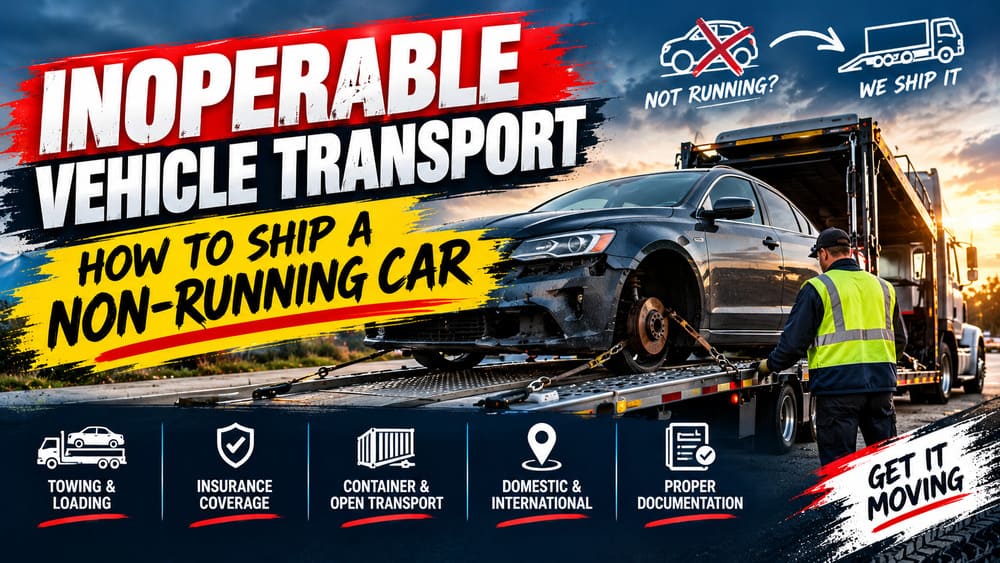
Bought a car that doesn’t run at an auction or from a seller across the country, and need it brought home? Yes, you can ship it, but it is one of the harder jobs in car shipping. Plenty of carriers will simply say no, and the ones that say yes charge more and may take longer to show up. Expect to pay about $150–$300 more than for the same car in running order, as long as it still rolls, steers and brakes. The single most important thing is to tell the company exactly what is wrong before a truck is dispatched. Most of the horror stories about inoperable vehicle transport start with a car that was booked as running.
Key findings
- Many carriers turn non-running cars down. A car carrier is built for cars that drive on and off. A dead car needs a winch, extra time and more planning, and not every driver has or wants that.
- Roll, steer, brake decides everything. If the car does all three, it can be winched onto a regular truck. If it can’t roll, you need a forklift or a flatbed at both ends.
- The usual surcharge is about $150–$300. For a 1,000-mile trip, a non-running sedan costs about $1,000–$1,550 on an open carrier instead of $850–$1,250.
- Waiting is the hidden cost. Fewer trucks can take your car, so on a quiet route it can take days longer to find one.
- Bought it far away? Plan both ends. Someone has to hand over the car and keys at pickup, and someone has to receive it at your end, where it may need to be rolled off and pushed into place.
Why many carriers say no to non-running cars
It helps to see the job from the driver’s side. A typical open car carrier takes 7 to 10 cars, and most of the day goes into loading, unloading and driving between stops. A car that can’t drive breaks that routine in several ways:
- No winch, no deal. Car carriers are designed for cars that drive up the ramps. Plenty of trucks don’t carry a winch at all, and those drivers can’t take your car even if they want to.
- It takes longer to load. Winching a car up a steep ramp, lining it up and strapping it down takes far longer than driving it on. Drivers are paid per car, so that time comes out of their day.
- It complicates the load. Cars are loaded in a set order: the top deck usually goes on first and comes off last, because cars on the lower deck can block the top ramp. A running car can be moved around at a stop in seconds. A dead car needs the winch every time it moves.
- The driver carries the risk. A car that won’t hold on the ramp can roll into another customer’s car, and a car that leaks fluid onto the car below is the driver’s problem. Non-running cars are more likely to do both.
- Surprises at pickup. Drivers know that “it rolls fine” sometimes turns out to mean “the wheels are locked.” Many would rather pass than lose half a day.
What this means for you: if a broker books your car, it goes onto a load board marked as inoperable. Carriers without a winch skip it, and if the price is low, the carriers with a winch skip it too. That is why a non-running car posted at a running-car price can sit for a week without a single taker. Paying the surcharge up front is usually what gets the car moving.
What counts as an inoperable vehicle?
In car shipping, an inoperable vehicle (often written “inop” or “non-running”) is any car that can’t be driven onto and off the trailer under its own power. The reason doesn’t matter: an engine that won’t start, a transmission that won’t engage, collision damage that makes the car unsafe to drive, or a classic that hasn’t run in years.
A dead battery is a gray area. If a jump start reliably gets the car running, ask the company whether it can go as running, and say so honestly. If you aren’t sure it will start on pickup day, book it as inoperable. That costs less than a wasted trip.
Rolls, steers, brakes: the three questions that decide the price
Before quoting, a good company will ask you three questions: does it roll, does it steer and do the brakes (or at least the parking brake) work? The answers decide how the car gets loaded, which trucks can take it and what it costs.
| Condition | How it is loaded | Which trucks can take it | Typical extra cost |
|---|---|---|---|
| Rolls, steers and brakes, but doesn’t run | Winched onto the trailer | Open or enclosed carriers with a winch | About $150–$300 |
| Rolls, but steering or brakes don’t work | Winch with extra help, or a flatbed | Few carriers; ask before booking | Quoted case by case |
| Doesn’t roll (locked or missing wheels, heavy damage) | Forklift or rollback at both ends | Specialized carriers only | Quoted case by case, often several hundred dollars more |
Steering matters because the driver has to guide the car up a narrow ramp in a straight line. Brakes matter because the decks are steep, and a car that can’t hold itself can roll into the one next to it.
How much does it cost to ship a non-running car?
Start with the normal price for your route and add the surcharge. These are our estimates for a sedan that rolls, steers and brakes, on an open carrier:
| Distance | Running sedan | Non-running sedan | Transit time |
|---|---|---|---|
| 500 miles | $625–$1,000 | $775–$1,300 | 1–3 days |
| 1,000 miles | $850–$1,250 | $1,000–$1,550 | 2–5 days |
| 1,500 miles | $1,025–$1,450 | $1,175–$1,750 | 3–6 days |
| 2,000 miles | $1,150–$1,650 | $1,300–$1,950 | 4–8 days |
| 2,800 miles (coast to coast) | $1,400–$2,000 | $1,550–$2,300 | 6–10 days |
An SUV or pickup costs more on top of this, and enclosed transport adds about 40–60%. Transit time doesn’t change once the car is loaded, but finding a truck with a winch can add a few days before pickup. The car shipping cost calculator opens with the non-running option already selected, so you can price your own addresses.
If a quote for a non-running car is the same as for a running one, ask why. Either the surcharge will show up later, which is one of the common reasons car shipping quotes go up after booking, or the company hasn’t understood the car’s condition.
Three common situations and what to do
You bought a non-running car at an auction
This is the most common case, and the clock is the problem. Salvage auctions usually give you only a few free days to collect a car, counting the day you bought it, and charge storage after that; fees vary by auction and location. The good news: the auction yard’s own staff move the car to the loading area and load it onto the truck, so pickup is usually easier than from a driveway. The hard part is the delivery end, where someone has to get the car off the truck. Book as soon as the auction closes, and pick a company that lists auction transport. Our directory has 76 companies that move auction cars. More tips in our guide to shipping a car bought online or at an auction.
You’re moving a project car or a classic that hasn’t run in years
Check the basics a few weeks before pickup: tires that hold air, wheels that turn, a brake pedal or parking brake that holds. Seized brakes are the usual reason a “roller” turns out not to roll. For a valuable or half-finished car, consider enclosed transport. Many enclosed trailers have a liftgate or a winch, and the car stays out of the rain, which matters if it is missing glass or seals.
You bought a non-running car from a private seller in another state
This one needs the most coordination, because you aren’t there. Agree with the seller before you pay that they (or someone they trust) will be at pickup with the keys, will let the driver test whether the car rolls and steers, and will sign the Bill of Lading with you on the phone. Ask the seller for a short video of the car being pushed in neutral and the wheels turning: it saves arguments at pickup. Make sure the title and bill of sale are signed over before the car leaves, since the driver won’t sort out paperwork. And check where the car actually sits. A car in a backyard or a tight garage may need to be pushed or towed to the street before a big truck can reach it.
What to tell the company before you book
The quote is only as good as what you tell the company. Give them these details in writing, ideally with photos:
- What exactly is wrong. “Won’t crank,” “no reverse,” “front-end damage, radiator leaking.”
- Whether it rolls, steers and brakes, and whether the parking brake holds.
- Whether it shifts into neutral. A car stuck in park can’t be winched.
- Whether all four wheels are on and the tires hold air.
- Whether you have the keys. Without them the steering column can stay locked.
- Where the car sits. A big truck may not fit into a narrow street or a parking garage, so the car may need to be pushed or towed to an open spot first.
- Who will receive it, and whether there is a level spot at delivery where the car can be rolled off and left.
You can copy and adapt this message when you ask for quotes:
Hi, I need a quote to ship a 2012 Honda Accord that doesn’t run (it doesn’t crank). It rolls, steers and the parking brake holds. It shifts into neutral, all four tires hold air and I have the keys. Pickup is from a driveway in Orlando, FL, with room for a truck on the street. Delivery is to a house in Columbus, OH. Please confirm your price includes the inoperable (winch) fee and that the truck you send has a winch.
How to prepare a non-running car for pickup
- Inflate the tires and check that the car rolls freely in neutral.
- Make sure the steering turns with the key in the ignition.
- Secure or remove loose parts: bumpers, trim, a hood held down with straps.
- Look under the car for leaks. A car that drips onto the vehicle below it can be refused.
- Take out personal items and loose spare parts unless the company agrees to carry them.
- Photograph every side and note existing damage on the Bill of Lading with the driver. Our car shipping checklist has a printable inspection form, and here is what to do if the car arrives damaged.
Mistakes that cost money
- Booking it as running to save the surcharge. When the car doesn’t start at pickup, the driver can leave it, charge the surcharge on the spot or bill you for the wasted trip. You still end up paying for a truck with a winch.
- Chasing the lowest quote. An inoperable car posted at a running-car price is the one that sits unclaimed for days.
- Forgetting the delivery end. A car that can be winched on can be winched off, but a car that doesn’t roll needs a forklift or a rollback at delivery too.
- Not knowing who will haul it. If you book through a broker, ask which carrier will pick up the car and check that it has a winch. Here is the difference between a broker and a carrier.
- Not checking the company. Any company that moves your car across state lines needs active FMCSA operating authority. Check it with our company lookup before you pay a deposit.
Where to find companies that ship non-running cars
Every company in our directory is checked against FMCSA records, and the companies list the services they offer. Some places to start:
- Companies that list inoperable vehicle transport: more than 30 companies across the country.
- Car shipping companies by state: open your state, then tick “Inoperable vehicle transport” in the filters to see local companies first.
- Auction transport companies, if your car is coming from a salvage or dealer auction.
- Enclosed car transport companies for classics and project cars.
Ask two or three of them to quote the same dates, and send each the same description of the car.
Methodology
Shipping prices come from our car shipping price model, the same one behind the cost calculator and the route guides on this site: an open-carrier price for a sedan by road distance, plus $150–$300 when the car doesn’t run. Loading practices come from carrier guides and published auction yard policies. Real quotes change with fuel prices, season and how many trucks with a winch run your route. Company counts are from our directory in October 2026.
Frequently asked questions
Can you ship a car that doesn’t run?
Yes, but not every carrier will take it. If the car rolls, steers and brakes, a carrier with a winch can load it. If it doesn’t roll, it needs a forklift or a flatbed at both ends.
Why do some car shipping companies refuse non-running cars?
Many trucks don’t have a winch, loading a dead car takes much longer, it complicates the order of cars on the trailer, and the driver carries the risk if the car rolls or leaks onto another vehicle.
How much more does it cost to ship an inoperable vehicle?
Usually about $150–$300 more than the same car in running order. A car that can’t roll at all is quoted case by case and often costs several hundred dollars more.
What does inoperable mean in car shipping?
The car can’t be driven onto and off the trailer under its own power, whatever the reason: a dead engine, a failed transmission, collision damage or a car under restoration.
Can I ship a car without keys?
Sometimes, but tell the company first. Without keys the steering column may stay locked, so the car can’t be steered up the ramp and may need a forklift or a flatbed.
Can I ship a non-running car I bought in another state if I can’t be at pickup?
Yes. The seller or anyone you trust can hand over the car and keys and sign the Bill of Lading at pickup. Tell the company who that person is, and make sure the title is signed over before the car leaves.