

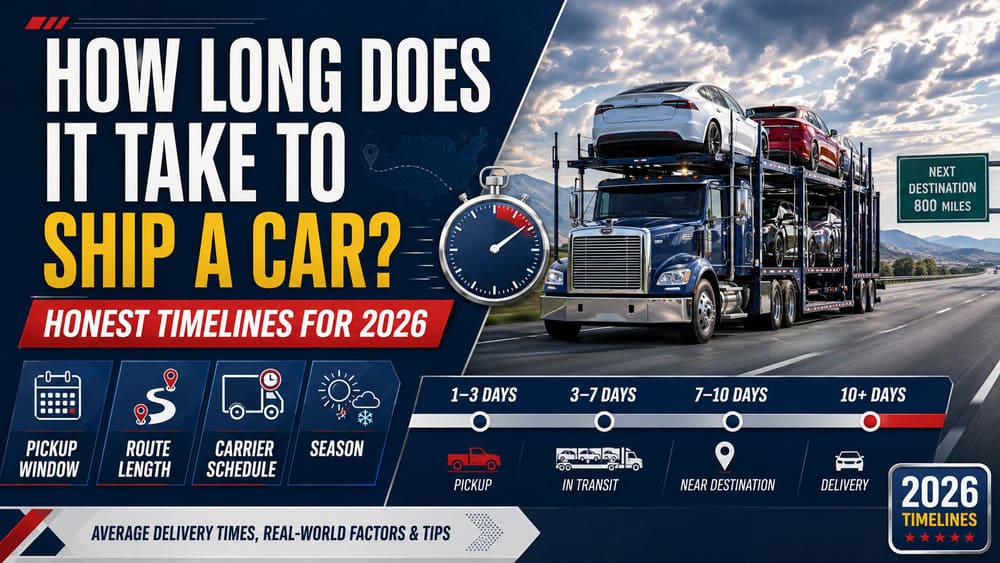
How long does it take to ship a car? Usually 1 to 14 days on the truck, depending on distance, plus 1 to 5 days before a carrier picks the car up. Pickup windows, how busy your route is, the season and where you live all move the total. This guide gives realistic timelines by distance and route, explains what causes delays and shows how to get your car moving sooner.
Key findings
- Transit time follows distance: about 1–3 days under 500 miles and 6–10 days coast to coast.
- The clock starts at pickup, not at booking. Expect 1–5 days for a carrier to be assigned and arrive.
- Busy routes move faster. Major metro areas and interstate corridors get trucks sooner than rural or off-route addresses.
- Short moves can wait longer than long ones, because carriers fill long, well-paid loads first.
- Flexible dates and open transport are the fastest combination. Expedited pickup costs extra and speeds up pickup, not the drive.
Car Shipping Timelines at a Glance
Before diving into details, here is a quick reference based on route distance:
| Route Distance | Estimated Transit Time |
|---|---|
| Under 500 miles | 1–3 days |
| 500–1,000 miles | 2–4 days |
| 1,000–2,000 miles | 4–7 days |
| 2,000–3,000 miles | 6–9 days |
| 3,000+ miles (cross-country) | 7–12 days |
These are transit times after the carrier picks up your vehicle. Add a pickup window of 1–5 business days to get your total wait from booking to delivery.
Why Car Shipping Takes Longer Than You Might Expect
Many first-time shippers are surprised to learn that the quoted transit time does not start when they book: it starts when the carrier actually picks up their vehicle.
Because carriers consolidate loads before departing, they wait until a truck is full or nearly full. Therefore, even if your vehicle is ready on day one, the carrier may not arrive for several days. This is standard practice across the industry, not a red flag.
Here is what adds time to the total process:
- Pickup window (1–5 days). After booking, most carriers provide a pickup window rather than an exact date. Flexible customers get better rates; customers with a hard pickup date may pay a premium.
- Route popularity. High-traffic routes like Florida to New York or California to Texas have more carriers running them regularly. Because demand is higher, pickups happen faster. Remote routes with fewer carriers take longer to schedule.
- Vehicle type. Oversized vehicles, such as trucks, large SUVs, lifted vehicles or inoperable cars, require special equipment. This limits carrier options and can extend your timeline.
- Weather and road conditions. Winter shipping across mountain passes or through the Midwest can cause delays. Carriers prioritize safety over speed.
How long does a dealership transfer take?
Big used-car retailers and dealer groups move cars between their own locations with their own trucks and outside carriers. When you request a transfer, the dealer gives you an estimated arrival date, and that estimate is the best guide: it depends on the distance between the two lots and how often trucks run between them. Transfers between nearby locations can take a few days, while cross-country transfers often take a couple of weeks or more.
A transfer is usually slower than booking your own car shipment, because the car moves on the dealer’s schedule together with its other inventory. If the date matters, confirm it with the store as it gets close. Buying from a dealer or private seller far away and arranging the shipping yourself? See shipping a car bought online, at auction or from a dealer.
How Long Does It Take to Get a Car Shipped? (Booking to Delivery)
To understand the full timeline from start to finish, it helps to break the process into stages:
Stage 1: Getting Quotes and Booking (1–3 days)
Request quotes from multiple carriers, compare options, and confirm your booking. Most people complete this in one to three days.
Stage 2: Pickup Window (1–5 days)
After booking, the carrier contacts you to schedule a pickup. Standard transport includes a 1–5 day window. If you pay for expedited pickup, this window shrinks.
Stage 3: Transit (1–14 days)
This is the actual driving time. A carrier hauling from Chicago to Dallas will typically take 2–4 days in transit. A carrier running from New York to Los Angeles may take 6–10 days.
Stage 4: Delivery Window (1–2 days)
Carriers provide a delivery window as well, not an exact hour. Plan for flexibility on the delivery end, especially for long-haul routes.
Total time from booking to delivery for a typical shipment: about 5 to 12 days, and up to about 15 days coast to coast.
Factors That Affect How Long It Takes to Ship a Car
Distance
Distance is the most obvious factor, but the relationship is not linear. A 1,000-mile haul does not take twice as long as a 500-mile one, because trucks on long interstate runs cover 400–500 miles a day. Short trips are not always quick either: a 300-mile move can wait longer for a truck than a cross-country one, because carriers fill long loads first. Why 300 miles costs like 1,000 explains it.
Open vs. Enclosed Transport
Open transport carriers run more frequently because they carry more vehicles per load. Therefore, open transport often has a shorter pickup window than enclosed. Enclosed carriers are less common, so scheduling can take a few extra days, especially for less-traveled routes.
Terminal vs. Door-to-Door Service
Door-to-door service brings the truck to your address, or as close as a large truck can safely get. It is the most convenient option and usually the fastest, because there is no waiting at a terminal. Terminal-to-terminal service means dropping off and picking up at a storage lot, which can add a few days at each end depending on the terminal’s schedule. Door-to-door vs terminal car shipping compares the two.
Season and Demand
Summer, June through August, is the busiest season, so pickup windows get longer. On the north–south snowbird routes, demand peaks in late fall, when snowbirds head south, and again in spring, when they return. Outside those peaks and outside the snowbird lanes, late winter is usually quieter, though storms can slow trucks in the north. See the best time to ship a car and snowbird car shipping for month-by-month detail.
Your Location
Major metro areas like Los Angeles, New York, Dallas, Miami, and Chicago have dozens of carriers running daily. Pickup windows are short. Rural or off-highway locations have fewer carriers, which means longer waits. If you live far from a major route, you may need to meet the carrier at a more accessible location to speed things up.
How to Reduce Your Car Shipping Timeline
If timing matters, here are practical steps to get your vehicle shipped faster:
- Book early. Two to three weeks in advance is ideal for standard routes. Peak season bookings made less than a week out often face delays.
- Be flexible on pickup. The more rigid your pickup date, the fewer carriers can accommodate you. A 3–5 day window gives carriers the flexibility to include your vehicle in their next available run.
- Choose open transport. Open carriers run more often. If speed matters more than maximum protection, open transport is typically faster than enclosed.
- Opt for door-to-door service. Eliminating terminal stops removes 1–3 days from each end of the journey.
- Use a populated pickup and delivery address. If your home is on a narrow street or in a rural area, consider meeting the carrier at a nearby parking lot or truck stop. This makes you easier to schedule and can shorten the pickup window.
- Ask about expedited shipping. Most carriers offer an expedited option for a higher fee. This prioritizes your vehicle on the next available truck departing your route.
How Long Does It Take a Car to Ship: Route-Specific Examples
Here are realistic timelines, from booking to delivery, for common US routes:
| Route | Distance | Typical Total Timeline |
|---|---|---|
| Los Angeles → San Francisco | ~380 miles | 3–6 days |
| Chicago → Dallas | ~920 miles | 5–8 days |
| New York → Miami | ~1,280 miles | 6–9 days |
| Atlanta → Denver | ~1,400 miles | 6–10 days |
| New York → Los Angeles | ~2,800 miles | 8–14 days |
| Seattle → Houston | ~2,100 miles | 7–12 days |
For your exact cities, our car shipping cost calculator shows an estimated price and days in transit, and each of our route guides lists road miles, typical transit time and the companies that serve the route.
What Can Cause Delays?
Even well-planned shipments sometimes run late. Here is what causes the most common delays:
- Weather. Ice storms, flooding, and hurricanes can close highways and force carriers to reroute. This is most common in winter across northern states and in hurricane season along the Gulf and East Coast.
- Mechanical issues. Trucks break down. It is rare, but when it happens, carriers arrange replacement transport as quickly as possible.
- Route changes. If a carrier loses other pickups on your run, they may combine your shipment with a different route, adding transit time.
- Inaccurate vehicle information. If you provided incorrect dimensions or failed to disclose that a vehicle is inoperable, the carrier may need to reschedule with appropriate equipment.
The best way to manage delays is to stay in touch with the driver or dispatcher and avoid hard commitments, like returning a rental car, until you have a confirmed delivery window. If your car still hasn’t been picked up days after booking, the price may be too low for carriers on your route: why a car shipping quote goes up after booking.
Frequently Asked Questions
How long does it take to ship a car across the country?
A coast-to-coast shipment, such as New York to Los Angeles or Miami to Seattle, typically takes 6 to 10 days from pickup to delivery. Add 1–5 days for the pickup window, so plan for 7 to 15 days total from your booking date.
How long does it take for a car to ship 500 miles?
A 500-mile route typically takes 2–4 days in transit. With a pickup window included, expect delivery within 4–8 days of booking.
How long does it take to ship a car from California to Texas?
California to Texas is about 1,400 to 1,700 miles depending on the cities. Transit usually takes 3–6 days, plus 1–5 days for pickup scheduling, so most cars arrive within about 5–10 days of booking. See the California to Texas route guide.
Does enclosed transport take longer than open transport?
Enclosed transport can take slightly longer because there are fewer enclosed carriers on most routes. Expect the pickup window to be 1–3 days longer than open transport for the same route.
Can I expedite car shipping?
Yes. Most brokers and carriers offer expedited pickup for an extra fee, often $150–$300 or more. It gets your car on the next available truck; the drive itself takes about the same time.
Why hasn’t my car been picked up yet?
Usually because no carrier has accepted the load yet. That happens when the price is below what trucks on your route are paying, the pickup is far from a main highway, or the dates are tight. Ask the company whether a carrier has been assigned, and by when.
Is it faster to drive my car myself?
For trips under about 500 miles, often yes. For cross-country moves, driving takes 4–6 days plus the cost of fuel, hotels and meals. Our ship or drive calculator compares the real cost for your route.
Before you book
Whatever company you choose, check its USDOT number in our free FMCSA company lookup before you hand over the car, and use the car shipping checklist to prepare it. Neither one makes the truck faster, but both prevent the delays that come from a problem at pickup.