

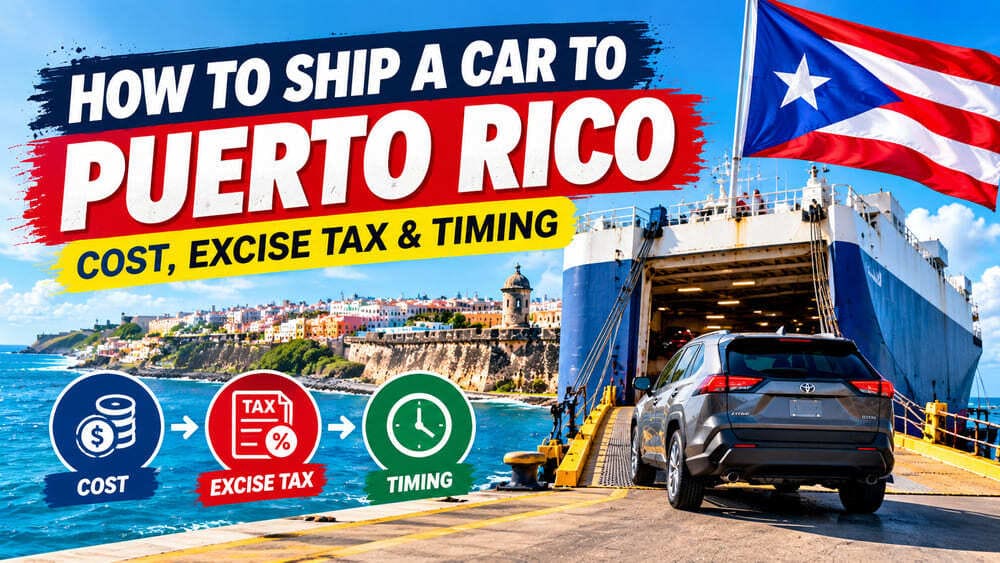
Shipping a car to Puerto Rico from the East Coast or the Midwest usually costs about $2,000–$2,800 all in for a sedan: roughly $850–$1,250 to truck it to the port in Jacksonville and another $1,150–$1,550 for the ship to San Juan. From Florida or Georgia it’s closer to $1,600–$2,500, and from California about $2,500–$3,400. Those numbers leave out the one cost that catches most people off guard, Puerto Rico’s excise tax on vehicles brought to the island, which you pay before the port will hand over your keys. Plan on one to three weeks from booking to driving away in San Juan.
Key findings
- It’s a three-part trip. A truck takes the car to a mainland port, a ship carries it to San Juan, and you pick it up at the terminal there. Most cars sail from Jacksonville.
- The ocean leg is the cheap part. A sedan costs about $1,150–$1,550 port to port. Getting the car to Florida often costs nearly as much.
- The excise tax can be bigger than the freight. Puerto Rico’s Treasury sets a taxable value for your car, not your purchase price, and the car stays at the port until the tax is paid.
- No passport, no customs duty. Puerto Rico is a US territory, so this is a domestic shipment. The excise tax is a local tax, not an import duty.
- The car goes empty. Ship lines want a quarter tank of fuel or less and nothing inside but what came with the car.
How shipping a car to Puerto Rico works
 Play
Nobody drives a car carrier onto a ship and off again in San Juan. The trip is split into legs, and different businesses handle each one.
- The truck leg. An auto transport carrier picks the car up at your home and drops it at the port terminal. If you live within a few hours of the port, you can skip this and drive it there yourself.
- The ocean leg. The car rolls onto a roll-on/roll-off ship, is strapped down on an enclosed deck and sails to San Juan. The crossing from Jacksonville takes a little over two days, and several sailings leave every week.
- Pickup in San Juan. You or someone you name collects the car at the terminal, after the excise tax is paid and the paperwork checks out.
You can book the legs separately, which is usually cheaper and gives you more control, or let a broker arrange both. If you go through a broker, ask whether the quote includes the ocean freight and port fees or only the truck to Florida. Plenty of “Puerto Rico” quotes turn out to be just the drive to Jacksonville.
Why so few choices on the water? Federal law requires cargo moving between two US ports to travel on ships that are US-built, US-flagged and crewed by Americans. Only a handful of ship lines run that service to Puerto Rico, and that keeps the ocean rate steadier, and higher, than the distance alone would suggest.
How much it costs to ship a car to Puerto Rico
Add the truck leg to the ocean leg. The table uses our price model for an open carrier from each city to Jacksonville and a typical published port-to-port rate for a sedan.
| Starting city | Truck to Jacksonville | Ship to San Juan | Total before excise tax |
|---|---|---|---|
| Orlando, FL | $425–$750 | $1,150–$1,550 | $1,575–$2,300 |
| Atlanta, GA | $550–$900 | $1,150–$1,550 | $1,700–$2,450 |
| Charlotte, NC | $575–$950 | $1,150–$1,550 | $1,725–$2,500 |
| New York, NY | $850–$1,250 | $1,150–$1,550 | $2,000–$2,800 |
| Chicago, IL | $850–$1,250 | $1,150–$1,550 | $2,000–$2,800 |
| Houston, TX | $850–$1,250 | $1,150–$1,550 | $2,000–$2,800 |
| Boston, MA | $925–$1,325 | $1,150–$1,550 | $2,075–$2,875 |
| Los Angeles, CA | $1,325–$1,875 | $1,150–$1,550 | $2,475–$3,425 |
A few things move these numbers:
- Size. Ship lines price by the space a vehicle takes up, so a tall SUV, a pickup or a van costs more on the water as well as on the truck.
- Fuel and extras. Show up with more than a quarter tank and the terminal can charge you to drain it. Marine insurance is usually offered on top of the freight.
- A car that doesn’t run. Expect to pay extra on both legs. Some sailings won’t take a non-running vehicle at all, so ask before you book. Our guide to shipping a non-running car covers the truck side.
- Season. The truck leg into Florida gets pricier from October through January, when snowbirds head south. The ocean rate barely changes through the year.
To price the truck leg from your own address, put Jacksonville in as the destination on the car shipping cost calculator.
The excise tax: the cost most people miss
Puerto Rico charges an excise tax, called arbitrios, on vehicles brought to the island, including used cars that already have years on mainland plates. It isn’t based on what you paid. The Puerto Rico Department of the Treasury (Hacienda) assigns the car a taxable value from its own tables and charges a percentage of that. On a late-model car the bill often runs into the thousands of dollars; on an older, cheaper car it’s far smaller.
Two things to know before you book:
- Get the estimate first. Hacienda’s online system gives an estimate from the 17-digit VIN, which is more accurate than entering the make and model. Run it on Hacienda’s SURI portal before you pay for any shipping. If the number is ugly, selling the car here and buying one on the island can come out ahead.
- No tax receipt, no car. The terminal in San Juan releases the vehicle only after the tax is paid. Every day it sits there waiting can add storage charges, so pay as soon as the car is on the way.
The tax rules have been the subject of reform talk in San Juan, and the rates and valuation tables change. We don’t quote a percentage here for that reason. Use the VIN estimate, and if anything about your case is unusual (a returning resident, military orders, a car you bought very recently), call Hacienda before the car ships.
How long it takes
| Stage | Typical time |
|---|---|
| Truck to Jacksonville (pickup window plus transit) | 1–3 days from the Southeast, 3–9 days from the Northeast, Midwest or Texas, up to 2 weeks from the West Coast |
| Waiting at the mainland terminal for the next sailing | 1–4 days |
| Ocean crossing | 2–3 days |
| Unloading, paperwork and tax in San Juan | 2–5 days |
| Booking to pickup | About 1–3 weeks |
The truck leg is where the time goes. A carrier has to fill a trailer heading toward Jacksonville, and the pickup date is a window, not an appointment. Each ship has a cutoff for receiving cars, so if the truck runs late you may miss a sailing and wait for the next one. Give yourself a few days of cushion and don’t book a flight to San Juan around the exact sailing date.
Papers and prep before the car ships
Ship lines are stricter than truck carriers, and they will turn a car away at the gate. Have these ready when you drop it off:
- the title (most terminals want the original or a certified copy) and current registration;
- a government photo ID that matches the owner on the title;
- if the car is financed or leased, a letter from the lender or leasing company allowing it to go to Puerto Rico, usually notarized and on letterhead (ask for it early, some lenders take a couple of weeks);
- if someone else is dropping off or picking up, a signed authorization from the owner.
Then get the car itself ready. Run the tank down to a quarter or less. Take everything out: bags, car seats, phone mounts, the toll transponder and the garage remote. Spare tire, jack and floor mats can stay. Turn off the alarm or tell the terminal how to. Wash the car before the truck comes so you can see every scratch when the driver writes up the inspection report, and take your own dated photos. Our car shipping checklist walks through the rest.
People ask whether they can pack the trunk the way they might for a move across state lines. For the ocean leg, no. Ship lines won’t carry personal goods in a car on a roll-on/roll-off sailing. If you need to send household things too, a container with a moving company is the way to do it. See can you pack belongings when shipping a car and do cars fit in shipping containers.
Getting the car to the port
If you live in Florida, south Georgia or the Carolinas, driving the car to the terminal yourself is often the cheapest move, and you hand it over in person. Everyone else needs a truck. Look for a carrier or broker that works the I-95 and I-10 lanes into Jacksonville regularly; they fill trailers faster and are used to port drop-offs, which have gate hours and paperwork that a home delivery doesn’t.
Our Jacksonville car shipping page lists the companies that serve the city, and the Florida page covers the rest of the state, including the ports in South Florida, where some sailings also leave. The route guides show prices and transit times for the truck leg from the busiest states:
The truck leg is regulated like any interstate move, so check the company’s USDOT number and operating authority in our car shipping company lookup before you sign. If a broker is arranging it, it helps to know who you’re actually hiring. The ship line is a separate business with its own terms, so ask what its liability covers for the crossing and whether the marine insurance it offers is worth buying. Our guide to car shipping insurance explains what the truck carrier’s cargo policy does and doesn’t pay for.
After the car lands in San Juan
Bring your ID, the bill of lading or booking number and the excise tax receipt to the terminal. Walk around the car before you drive off and note any new damage on the release paperwork right there. Once you leave the gate, a damage claim gets much harder. If you do find something, our page on what to do if your car is damaged during shipping lays out the steps.
If you’re staying, the car has to be registered in Puerto Rico through the island’s Department of Transportation and Public Works (DTOP). Expect to bring the title, the paid excise tax document, your ID and proof of a Puerto Rico address, and to have the car inspected. A car coming from the mainland isn’t in the local system yet, so the first annual registration sticker, the marbete, is usually bought at a Treasury collection office rather than at an inspection station. The marbete fee includes Puerto Rico’s compulsory basic insurance, which is not the same as full coverage. Don’t sit on the registration; start it in your first weeks on the island. For how registration deadlines work on the mainland, see registering a car in a new state.
Shipping a car back from Puerto Rico
Going the other way takes more paperwork on the island side. Before a car can leave San Juan, the owner usually needs a police inspection certificate and a DTOP document showing there are no unpaid fines, and both are valid for only a few days. Line those up close to your sailing date, not weeks ahead. On the mainland end it works like any other delivery: the car comes off the ship in Jacksonville and a truck takes it home.
Puerto Rico, Hawaii and overseas shipping
Puerto Rico sits in between. Like Hawaii, it’s a domestic ocean shipment: no customs, no export filing, and the same “empty car, quarter tank” rules. If you’ve read our guide to shipping a car from San Diego to Hawaii, most of the process will look familiar. The difference is the excise tax, which Hawaii doesn’t charge. Shipping to another country is a different job altogether, with export paperwork, foreign customs and import duty; the costs are in how much it costs to ship a car internationally.
Methodology
Truck-leg prices and transit times come from the price model behind our car shipping cost calculator: a running sedan on an open carrier, with road miles from each city to Jacksonville estimated from map distance. The port-to-port range reflects published standard rates for a sedan from Jacksonville to San Juan in 2026; larger vehicles cost more. The crossing time and sailing frequency come from published ship line schedules. Excise tax, registration and export requirements are summarized from Puerto Rico government guidance and terminal requirements as of October 2026 and change from time to time. All figures are estimates, not quotes.
Frequently asked questions
How much does it cost to ship a car to Puerto Rico?
About $1,150–$1,550 for a sedan from Jacksonville to San Juan, plus the truck to the port if you don’t drive it there. From the Northeast, Midwest or Texas the total is usually $2,000–$2,800. Puerto Rico’s excise tax comes on top.
What is the cheapest way to ship a car to Puerto Rico?
Drive the car to the Jacksonville terminal yourself and book the ocean leg directly. If you can’t, book an open carrier to the port with a flexible pickup window and avoid the October to January snowbird rush into Florida.
How long does it take to ship a car to Puerto Rico?
The ship takes two to three days from Jacksonville. With the truck leg, the wait for a sailing and pickup in San Juan, most people have the car in one to three weeks.
Do I pay customs or import duty to ship a car to Puerto Rico?
No customs duty, because Puerto Rico is a US territory. You do pay Puerto Rico’s own excise tax on the vehicle before it’s released at the port in San Juan.
Can I ship a financed or leased car to Puerto Rico?
Yes, with a letter from the lender or leasing company that allows the car to go to the island. Ship lines ask for it at drop-off, so request it as soon as you decide to ship.
Can I put my things in the car?
No. Roll-on/roll-off sailings take the car empty except for factory items like the spare tire and jack. Send belongings separately or in a container with a moving company.